


Florida has emerged as the most dynamic business environment in the United States for the year 2026. With its strategic economic policies, zero personal income tax, and a rapidly expanding consumer base, the state attracts thousands of entrepreneurs annually. However, forming a Limited Liability Company in Florida requires more than just submitting paperwork to the state of registry. It demands a sophisticated understanding of state statutes, compliance calendars, and internal governance. This guide is designed to provide you with the professional depth needed to navigate the Florida business landscape successfully.
The Strategic Economic Landscape of Florida in 2026
Before diving into the registration process, it is essential to understand why Florida is the preferred choice for business entity formation. The state has invested heavily in digital infrastructure, making the official state business portal a centralized hub for all business activities. Entrepreneurs are shifting toward the LLC structure because it provides the legal protection of a corporation without the administrative burden of double taxation.
By maintaining your entity in Florida, you are positioning your business within a jurisdiction that favors operational growth. The lack of personal income tax means that for small business owners and freelancers, the LLC is the most efficient vehicle to retain earnings. Yet, the legal benefits are contingent upon your ability to maintain strictly compliant records. Entrepreneurs often utilize resources like business formation tools to ensure they are on the right track from day one.
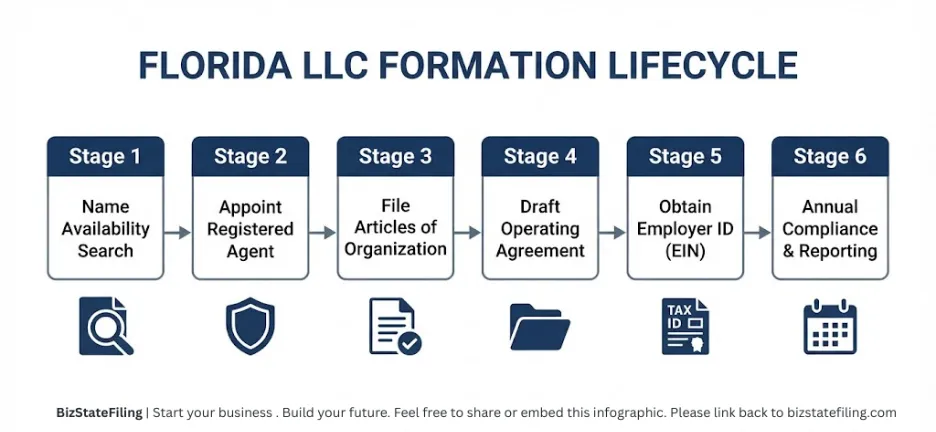
Step 1: Navigating Name Availability and Compliance
Your business name is the first asset of your company. In Florida, the requirements for naming an LLC are strict and enforced by the Department of State. Under the Florida Statutes, your name must be distinct from any other entity currently listed in the state of records.
The Mechanics of Name Distinguishability
A name is considered distinguishable if it does not cause confusion in the public record. For example, if there is a company named Apex Solutions LLC, you cannot register Apex Solutions Florida LLC. The state will reject the filing. You must conduct a search on the official state business registry to ensure your desired name is available.
|
Naming Requirement |
Legal Standard |
|
Entity Designator |
Must contain LLC, L.L.C., or Limited Liability Company |
|
Restricted Terms |
Bank, Trust, or University require regulatory approval |
|
Character Limits |
Max characters allowed by state database systems |
|
Fictitious Names |
Required if doing business under a name other than the legal entity |
If you plan to operate under a different name, you must file a Fictitious Name Registration. This is a separate filing from your Articles of Organization and is a common area where businesses incur unnecessary state fines due to noncompliance.
Step 2: Appointing a Strategic Registered Agent
The Registered Agent is the most critical link between your business and the state of Florida. Their primary responsibility is to accept service of process, tax notices, and annual report notifications. If you fail to maintain a registered agent, you risk administrative dissolution.
Internal vs Professional Registered Agents
Many startup owners attempt to serve as their own registered agent to save costs. While this is legally permissible, it creates significant risks to your privacy and operational continuity. Your address becomes a matter of public records. Furthermore, if you are not present during business hours, you may miss critical legal filings, leading to default judgments against your company.
A professional registered agent provides a permanent street address, ensuring that legal documents are received, scanned, and forwarded to you immediately. This is particularly important for virtual businesses or those that operate across multiple states.
Step 3: Filing the Articles of Organization with Precision
The Articles of Organization represent the legal birth certificate of your LLC. When you file this through the Florida Division of Corporations, you are making binding declarations about your business's intent and structure.
Core Elements of the Articles
Principal Office Address: This must be a physical address, not a PO Box. This is where your financial records and annual reports will be associated.
Mailing Address: You can use a PO Box here, but it must be different from the principal office address if that is a physical street address.
Registered Agent Details: The name, address, and the signature of the agent indicating their acceptance of the role.
Management Structure: You must decide between member managed or manager managed. Member managed is the default, where owners participate in daily operations. Manager managed is suitable for companies with passive investors or a board like structure.
Accuracy is vital. Even a minor typo in your principal address can cause significant issues when you attempt to open an break even account later. Banks perform a cross check between your Articles of Organization and your operating documents.
Step 4: The Crucial Role of the Operating Agreement
The Operating Agreement is the internal contract that keeps your LLC from being governed by the default rules of Florida law. While Florida statutes do not require you to file this document with the state, it is the document that will protect you in court.
Why Default State Rules Fail Entrepreneurs
If you do not have an Operating Agreement, the state of Florida applies its default rules to your business. This means if a dispute arises, the state decides how to handle member withdrawal, profit distribution, and voting rights. By writing your own agreement, you dictate the terms of your business life.
|
Clause |
Purpose |
|
Capital Contributions |
Defines initial funding and ownership stakes |
|
Voting Procedures |
Outlines how major decisions are approved |
|
Profit Distribution |
Specifies when and how members receive payouts |
|
Dissolution Protocol |
Determines the steps if the business fails or is sold |
Every member of your LLC should sign this document, and it should be kept securely in your corporate records book.
Step 5: Federal and State Tax Registration Requirements
After your LLC is approved, you must secure an Employer Identification Number (EIN). This is not just for hiring employees; it is required for your bank account, credit applications, and federal tax filings.
Federal EIN Application
You apply for an EIN directly through the IRS portal. There is no fee for this. You will need your LLC approval documentation on hand. It is a common mistake for businesses to use their social security number instead of an EIN, which exposes them to identity theft and tax audit risks.
Florida Tax Obligations
Beyond federal requirements, Florida imposes specific taxes on businesses. You may be liable for the following:
-
Reemployment Tax: If you hire employees, you must register for this state level tax.
-
Sales and Use Tax: If you sell taxable goods or provide specific services, you must register for a sales tax permit through the Florida Department of Revenue.
-
Local Business Taxes: Many cities and counties require a local business tax receipt, which is essentially a local permit to conduct business in that jurisdiction.
Step 6: Mastering the Annual Report Compliance Calendar
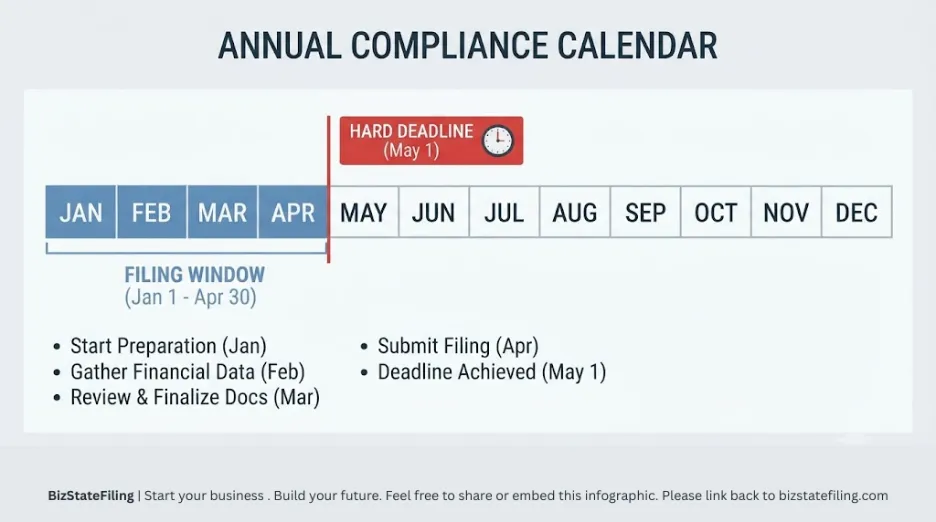
Florida law is very clear on annual reporting. Every LLC must file an Annual Report with the Department of State between January 1 and May 1 of each year. This is the only way to confirm that your company is still active and that your registered agent is still available.
The Cost of Forgetting the Deadline
If you miss the May 1 deadline, the state automatically assesses a 400 dollar late fee. If you continue to ignore this obligation, the Department of State will eventually initiate an administrative dissolution of your LLC. This would result in the loss of your limited liability protection, meaning your personal assets could once again be targeted for business debts.
|
Timeline |
Action Required |
|
January 1 |
Filing window opens |
|
April 15 |
Recommended date for final review |
|
May 1 |
Absolute deadline to avoid fines |
|
May 2 |
Mandatory 400 dollar late fee applied |
Use the business formation resources available to track these deadlines. A digital reminder system is an essential part of your annual operations.
Comparing the LLC to Other Business Entities
When choosing an LLC, it is helpful to look at how it performs against other common structures. Many entrepreneurs mistakenly choose a C-Corporation thinking it is more prestigious, only to face double taxation.
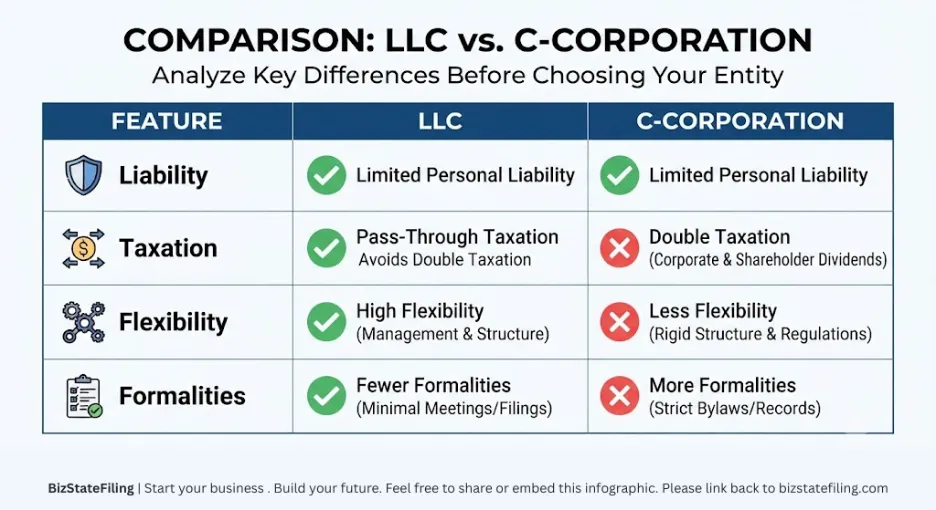
LLC vs Sole Proprietorship: The LLC provides a layer of legal separation between you and your business. A sole proprietorship offers no protection for personal assets.
LLC vs C-Corporation: The C-Corporation is often preferred only if you intend to go public or have complex venture capital requirements. For most small and medium businesses, the LLCs' pass through taxation is superior.
LLC vs S-Corporation: An S-Corp is a tax designation, not a business entity. You can form an LLC and choose to be taxed as an S-Corp, giving you the best of both worlds.
The Financial Importance of Organizational Structure
As you scale out your Florida LLC, the separation between personal and business finances becomes even more critical. Commingling funds mixed with personal expenses with business income is the fastest way to pierce the corporate veil. If you are ever sued, and the court finds that you have been using your business bank account as a personal piggy bank, the judge can ignore your LLC status and hold you personally liable.
Always maintain a separate freelance tax strategy. Using a dedicated bank account and professional accounting software will save you thousands of dollars during tax season and prevent compliance headaches.
Scaling Your Operations in the Florida Market
Once your compliance is sorted, your focus should be on strategic growth. Florida offers a massive market. Whether you are in professional services, retail, or manufacturing, the state has various industry specific incentives. Contact your local chamber of commerce to learn about specific regional grants or economic development programs that you may qualify for as a registered Florida entity.
Building an LLC is not a onetime event; it is a long term commitment to professional standards. Every contract you sign, every employee you hire, and every tax form you file adds to the value and durability of your business entity.
Deep Dive: Why Compliance Matters Beyond the Surface
Compliance is often dismissed by new founders as mere bureaucracy. However, seasoned entrepreneurs view it as an insurance policy. When you operate in a high growth state like Florida, you must be prepared for scrutiny from various agencies. Regular audits of your corporate records are necessary to ensure that you are not just compliant with the state but also optimized for tax efficiency.
Maintaining your business filing status is a continuous task. It requires you to be proactive about your record keeping. Whether it is updating your contact information with the state or ensuring that your operating agreement reflects current ownership percentages, every detail matters. When you fail to update these records, you create a trail of inconsistencies that can be exploited in legal disputes.
The Role of Technology in Modern Compliance
In 2026, technology is the backbone of efficient LLC management. You should leverage cloud based platforms to keep your corporate minutes, resolutions, and financial statements accessible. This transparency not only helps during tax season but also makes your business much more attractive if you ever decide to seek external investment or sell your entity. A well organized digital binder is a hallmark of a professional grade LLC.
Frequently Asked Questions
1. How long does the Florida LLC registration process take?
Online processing usually takes 3 to 5 business days, provided there are no errors in your filing.
2. Is it possible to have an LLC without a physical office in Florida?
You need a registered office, which must be a physical address in the state. You cannot use a PO Box for this, though you can use a professional registered agent service to fulfill this requirement.
3. Can a non-US resident form an LLC in Florida?
Yes, Florida is very friendly to international entrepreneurs. You do not need to be a US citizen or resident to own a Florida LLC.
4. Is the Operating Agreement filed with the Division of Corporations?
No, this is an internal document that you must create and keep in your own records. It is not a public record.
5. What happens if I forget to file my Annual Report by May 1?
You will be charged a mandatory 400 dollar late fee. It is best to set up an alert on the state registry portal to receive email notifications.
6. Do I need a separate business license for every city I operate in?
It depends on the city or county ordinances. You should check the local business tax office for every location where you have a physical presence.
7. Can I change my management structure after the LLC is formed?
Yes, you can amend your articles or change your operating agreement, but you must ensure your internal records reflect these changes correctly.
8. Is an LLC the same thing as a tax classification?
No, an LLC is a legal entity created by state law. How it is taxed is decided by the IRS based on your filings.
9. How do I verify that my Florida LLC is in good standing?
You can perform a search on the official state database using your entity name or filing number to see your status.
10. What is the most common reason for LLC rejection in Florida?
Most rejections occur due to incorrect address formatting or attempting to use a restricted word in the business name without prior authorization.
Conclusion
Forming your LLC in Florida is a milestone that signals your readiness to operate at a professional level. By adhering to the steps outlined in this guide, from careful name selection to diligent annual compliance, you provide your business with the strongest possible legal foundation. Success in the Florida market is built on the consistency of your operations and your commitment to staying ahead of regulatory requirements. Keep your documents organized, your compliance calendar updated, and your financial records clean, and you will be well equipped to grow your venture for years to come.
 Perplexity
 Claude
 Grok
Grok