


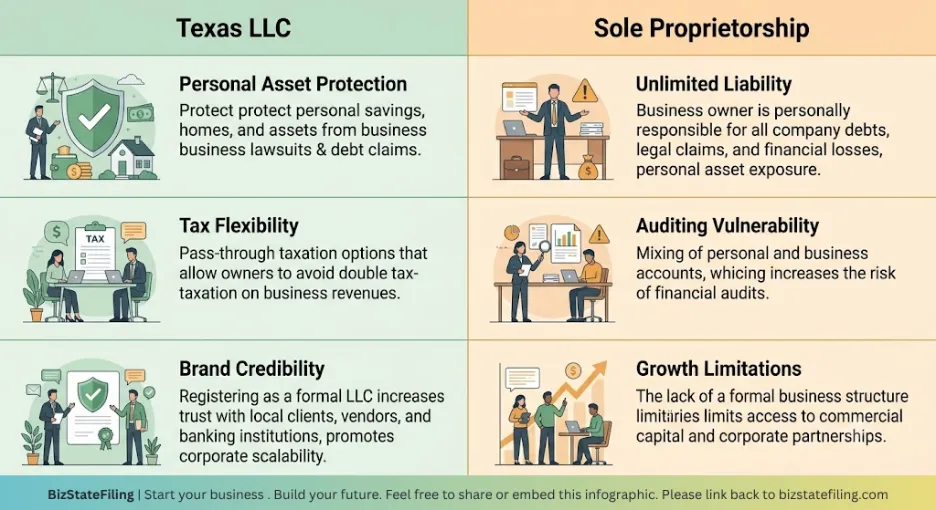
Establishing a limited liability company in Texas is one of the most effective strategies for protecting personal assets while building a scalable commercial enterprise. Known for its business friendly regulatory framework, robust infrastructure, and absence of state personal income tax, Texas represents a premier destination for global corporations and local startups alike.
To successfully launch your enterprise, navigating the official state procedures is crucial. From running initial name availability checks to understanding your ongoing tax obligations with the Texas Comptroller of Public Accounts, each step requires attention to administrative detail. By structuring your business properly, you establish a solid foundation for growth while ensuring compliance with state and federal laws.
When selecting your business location or analyzing local commercial markets, evaluating regional demographic shifts and demographic insights can help you identify high growth consumer corridors and optimize your expansion strategy.
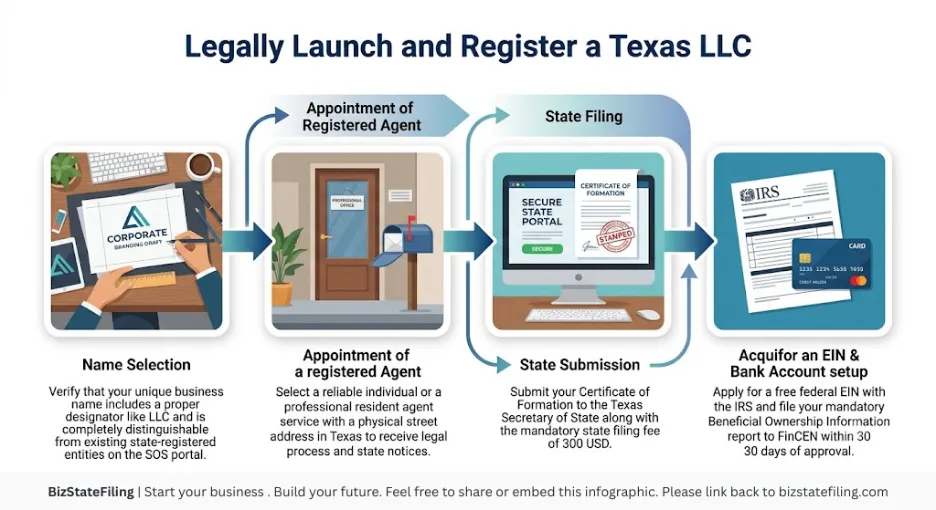
Step 1: Select a Compliant and Unique Business Name
The first legal requirement for forming a Texas LLC is selecting a name that is completely distinguishable from all other active entities registered with the Texas Secretary of State. Under the Texas Business Organizations Code, your business name must meet specific statutory guidelines to be accepted for filing.
Your chosen name must contain a proper designator indicating its corporate structure. Accepted terms include Limited Liability Company, Limited Company, or abbreviations such as LLC, L.L.C., LC, or L.C. Additionally, the name cannot contain words that imply association with government agencies or highly regulated industries without explicit written authorization from state regulatory bodies.
The following directory outlines the naming parameters and restricted words that require administrative clearance prior to filing Form 205.
|
Name Category |
Permitted Suffixes / Terms |
Restricted Terms |
Required Regulatory Clearance |
|
Suffixes and Designators |
LLC, L.L.C., Limited Liability Company, LC, L.C., Limited Company |
Corp, Inc, Incorporated, Co, Corporation |
Not Permitted for LLCs |
|
Financial Institutions |
Credit Union, Trust, Fiduciary, Savings, Depository |
Bank, Banking, Trust Company |
Texas Department of Banking |
|
Educational Entities |
Academy, Institute, Training Center |
College, University, School |
Texas Higher Education Coordinating Board |
|
Government Affiliation |
Private Enterprise, Consult, Services |
State Department, Federal, Agency, Treasury |
Not Permitted |
|
Professional Associations |
Association, Alliance, Group |
Engineering, Medicine, Legal, CPA |
Texas Board of Professional Engineers / Land Surveying |
Before submitting formal registration documents, you must perform a comprehensive name search using the SOS Direct portal. This prevents immediate rejection of your state's filings. If you have finalized your name but are not yet ready to file your primary formation paperwork, you can submit Form 501 along with a forty dollar state filing fee to reserve the name for up to one hundred and twenty days.
Before transmitting highly sensitive personal documents, identification scans, or draft filing materials across public portals, smart operators utilize a data sanitization tool to strip hidden metadata and protect their digital privacy.
Step 2: Appoint a Reliable Texas Registered Agent
Texas law requires every LLC to continuously maintain a registered agent and a registered office address within the state. A registered agent is an individual or a professional business entity authorized to receive service of process, official correspondence, and state tax notices on behalf of the company.
The registered agent must be a physical resident of Texas, or a registered business entity authorized to conduct operations in the state. The registered office must be a physical street address in Texas where the agent is physically present during standard business hours. P.O. Box addresses or virtual offices that do not provide physical receipt confirmation are strictly prohibited under state compliance codes.
When selecting your agent, you can choose to self appoint, designate an internal employee, or utilize a professional agency. The evaluation table below compares these administrative methods.
|
Evaluation Metric |
Self Appointment (Owner) |
Employee Designation |
Professional Registered Agent Service |
|
Annual Cost |
Zero Dollars |
Included in Employee Salary |
100 to 300 USD annually |
|
Privacy Protection |
None (Home address is public) |
Limited (Company address is public) |
High (Professional address listed publicly) |
|
Physical Availability |
Must be present 9 to 5 daily |
Must remain at office during hours |
Guaranteed physical presence during all business hours |
|
Receipt of Legal Notices |
Delivered directly in front of clients |
Delivered at place of business |
Handled discretely at professional office and scanned |
|
Multi State Compliance |
Limited to physical location |
Restricted to state of residency |
Seamless expansion to multiple jurisdictions |
While an LLC owner or manager can legally act as their own registered agent, many choose to hire a professional registered agent for service. Doing so protects your personal privacy, as the registered agent's physical address becomes a matter of public records. It also ensures that legal documents are received professionally without disrupting your daily business operations.
Step 3: File the Texas Certificate of Formation (Form 205)
The formal creation of your business entity occurs when you file the Certificate of Formation with the Texas Secretary of State. Known officially as Form 205, this document outlines the fundamental administrative structure of your limited liability company.
To complete Form 205, you must provide several key pieces of corporate information:
-
The exact legal name of the LLC is correct.
-
The name and physical address of your appointed registered agent.
-
The principal office address of the company.
-
The management structure (whether the company will be managed by its members or by appointed managers).
-
The name and address of each initial organizer of the entity.
The filing fee for a Texas Certificate of Formation is three hundred dollars. Filing online through the SOS Direct system or the SOS Upload portal is highly recommended, as digital filings are processed in a fraction of the time compared to paper documents submitted via mail. Digital payments are subject to a standard state credit card convenience surcharge.
The table below outlines the file submission methods, mandatory state fees, and expected processing times.
|
Submission Method |
Base State Fee |
Surcharges & Convenience Fees |
Processing Timelines |
Best Suited For |
|
Online (SOS Direct Portal) |
300 USD |
2.7 Percent Credit Card Fee |
2 to 3 Business Days |
Standard domestic formations seeking immediate approval |
|
Online (SOS Upload System) |
300 USD |
2.7 Percent Credit Card Fee |
3 to 5 Business Days |
Custom formations with complex, nonstandard terms |
|
Traditional Mail (Form 205) |
300 USD |
None (Check or Money Order) |
3 to 5 Business Weeks |
Physical document archiving and bulk filing submissions |
|
Expedited In Person Filing |
300 USD |
25 USD Expedited Handling Fee |
Same Day or Next Day |
Time sensitive corporate acquisitions and contracts |
Step 4: Draft a Comprehensive LLC Operating Agreement
An operating agreement is an internal corporate document that outlines the ownership structure, member responsibilities, financial distributions, and voting rights of the limited liability company. Unlike the Certificate of Formation, the operating agreement is not filed with the Texas Secretary of State.
Although Texas law does not mandate the creation of a written operating agreement, drafting one is highly recommended for all multi member and single member entities. A comprehensive agreement serves several vital functions:
-
It solidifies your personal liability protection by demonstrating that the LLC is run as a separate legal entity.
-
It prevents internal structural disputes by establishing clear rules for capital contributions, profit distribution, and member exits.
-
It is frequently required by financial institutions when opening commercial business bank accounts or applying for lines of credit.
Your startup budgets and early stage capital requirements can be accurately organized using professional business calculators to model multiyear operational expenses, equipment lease financing, and amortization schedules.
Step 5: Acquire a Federal Employer Identification Number (EIN)
A Federal Employer Identification Number, commonly referred to as an EIN, acts as a social security number for your business entity. Issued directly by the Internal Revenue Service, this nine digit number is required for tax reporting, hiring employees, and navigating professional financial markets.
You can apply for an EIN online through the official Internal Revenue Service website at no cost. The online application processes instantly, providing your official IRS confirmation letter immediately upon completion. If you are a foreign national or do not possess a Social Security Number, you can still acquire an EIN by submitting Form SS-4 via fax or traditional mail.
With your EIN secured, you can establish a dedicated business bank account. Keeping your personal and business transactions strictly separated is critical; commingling funds can compromise your corporate shield, leaving your personal assets vulnerable in legal proceedings.
Step 6: File Texas Franchise Tax and Public Information Reports
Texas has a unique business tax structure that every LLC owner must understand to maintain good standing. Instead of a traditional corporate income tax, the state imposes a Franchise Tax on the privilege of doing business within Texas borders.
For the franchise tax reports due on or after January 1, 2026, the Texas Comptroller of Public Accounts has established the No Tax Due annualized total revenue threshold at 2.65 million dollars. If your LLC’s annualized total gross revenue falls at or below this figure, your company owes zero state franchise tax. However, you must still file an annual Public Information Report (Form 05-102) to maintain active legal status.
The layout below outlines the corporate tax brackets, minimum filing standards, and late penalty schedules for the 2026 tax year.
|
Tax Category |
2026 Statutory Rate |
Thresholds & Qualification Metrics |
Filing Deadline |
Non Compliance Consequences |
|
No Tax Due Tier |
0.00 Percent |
Under 2.65 million USD Annual Revenue |
May 15 Annually |
50 USD Late Fee plus Charter Forfeiture |
|
Standard Business Rate |
0.75 Percent |
Over 2.65 million USD (Non Retail/Wholesale) |
May 15 Annually |
5 Percent Penalty escalation plus Interest |
|
Retail and Wholesale Rate |
0.375 Percent |
Over 2.65 million USD (Qualifying Retail) |
May 15 Annually |
10 Percent Penalty after 30 days delinquency |
|
EZ Computation Option |
0.331 Percent |
Total Revenue under 20 million USD |
May 15 Annually |
Audit vulnerability and retrospective assessment |
|
Public Information Report |
0 USD Submission Fee |
Mandatory for all active Texas LLCs |
May 15 Annually |
Immediate loss of state Certificate of Fact status |
Franchise Tax and Public Information Reports are due by May 15 of every year, starting the calendar year after your LLC was formed. Failure to file these documents on time results in an immediate fifty dollar late penalty, followed by additional interest charges and the potential forfeiture of your company’s corporate charter.
Navigating Federal Compliance: The BOI Exemption
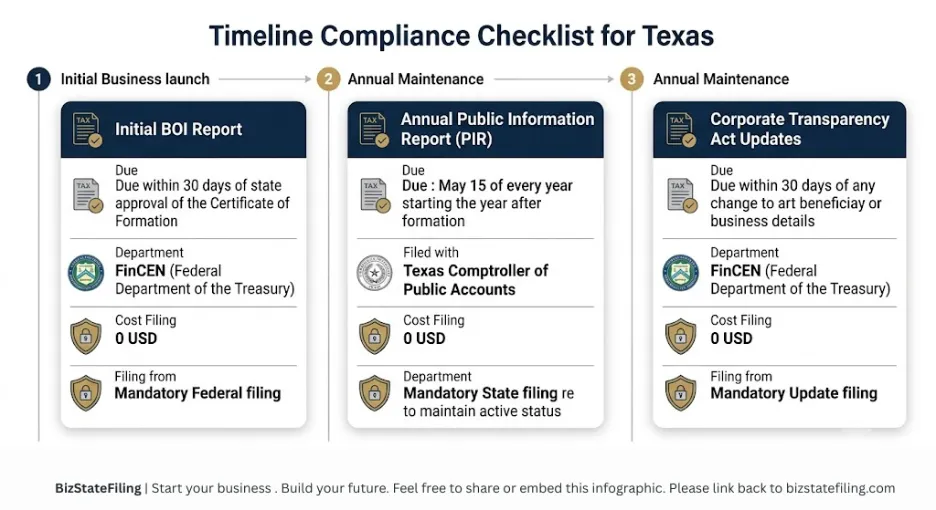
In addition to state level filings, business owners must stay aware of evolving federal requirements. Historically, the Corporate Transparency Act required many businesses to submit a Beneficial Ownership Information report to the Financial Crimes Enforcement Network (FinCEN).
However, under the latest federal compliance adjustments, domestic entities formed under state law within the United States are currently exempt from the active BOI reporting requirements. This major regulatory update eliminates unnecessary administrative burdens for small business owners, though foreign registered entities operating in the United States must still monitor their specific federal filing timelines closely.
Estimating Your Startup and Maintenance Budget
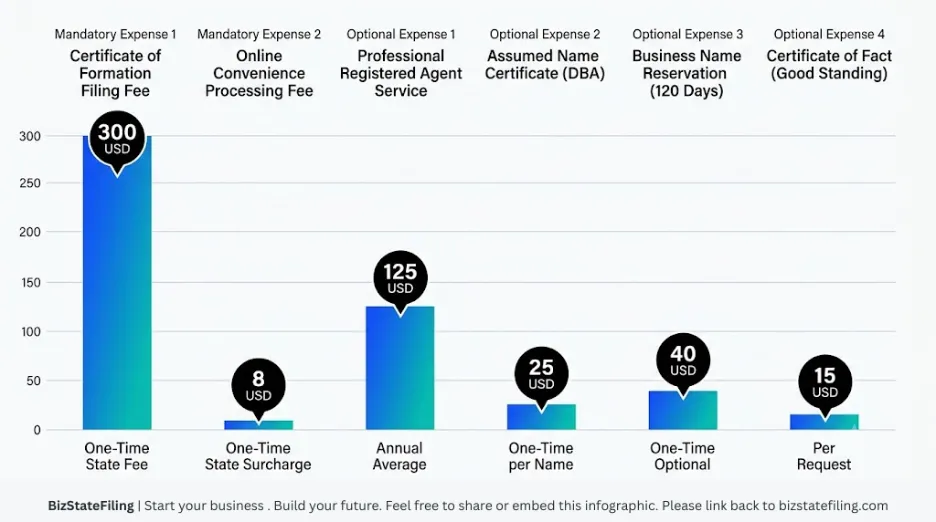
Before launching your operations, budgeting for both your immediate creation expenses and your predictable ongoing maintenance fees is critical for sustainable financial management.
|
Expense Category |
State Filing Fee |
Filing Frequency |
Mandatory vs. Optional |
|
Certificate of Formation (Form 205) |
300 USD |
One Time State Fee |
Mandatory |
|
Online State Convenience Surcharge |
8 USD |
One Time Surcharge |
Mandatory (Online Filings) |
|
Registered Agent Service |
100 to 300 USD |
Annual Recurring |
Optional (Free if Self Appointed) |
|
Assumed Name Certificate (DBA) |
25 USD |
Per Name filed (10 years) |
Optional |
|
Business Name Reservation (Form 501) |
40 USD |
One Time (120-Day Hold) |
Optional |
|
Public Information Report Filing |
0 USD |
Annual (Due May 15) |
Mandatory (Comptroller) |
|
Certificate of Fact (Good Standing) |
15 USD |
Per Request |
Optional |
To ensure that your ongoing operational expenses do not drain your cash flow, managing your digital overhead is highly advised. Incorporating a modern subscription tracking tool allows you to audit recurring SaaS software licenses, cloud storage accounts, and digital marketing platforms efficiently.
Brand Visibility and Local Discoverability
Once your legal paperwork is complete and your tax accounts are established, your focus must shift toward market positioning and consumer acquisition. Building an online presence is vital for capturing modern high intent consumer traffic.
To establish local authority and attract nearby clients, maximizing your brand’s discoverability by registering your entity on an active local business platform is a highly effective way to bolster your geographic search presence and connect with regional customer networks.
Frequently Asked Questions
1. How much does it cost to form an LLC in Texas?
The mandatory state fee to file a Certificate of Formation (Form 205) is 300 USD. If you submit the filing online, the state applies a small credit card convenience fee of approximately 2.7 percent, bringing the base cost to roughly 308 USD. Optional expenses include name reservations, professional registered agent services, and filing for assumed names.
2. How long does it take for the state to approve a Texas LLC?
Filing online through the SOS Direct portal is the fastest method, with approvals typically processed within two to three business days. Paper filings submitted through standard mail can take anywhere from three to five weeks to process depending on the volume of documents currently being handled by the Secretary of State’s administrative offices.
3. Can I act as my own registered agent in Texas?
Yes, you can legally appoint yourself, an employee, or a willing member of your LLC as your registered agent, provided the person is a physical resident of Texas, maintains a physical street address within the state, and is consistently available at that address during standard business hours to accept legal service of process.
4. Is an Operating Agreement required to be filed with the state?
No, the operating agreement is an internal document and is not filed with the Texas Secretary of State. While the state does not require a written agreement to form an LLC, maintaining one is highly recommended to protect your corporate veil, define internal partnership rules, and satisfy bank compliance requirements when opening commercial accounts.
5. Does Texas require LLCs to pay state income tax?
Texas is one of the few states in the nation that does not impose a personal state income tax or a traditional corporate income tax. However, all Texas LLCs are subject to the annual Texas Franchise Tax, which is calculated based on your total business revenue and industry specific margins.
6. What is the 2026 Texas Franchise Tax threshold for small businesses?
For franchise tax reports due on or after January 1, 2026, the no tax due threshold is set at 2.65 million USD in annualized total revenue. LLCs with annualized revenues at or below this threshold owe zero dollars in franchise tax, though they are still legally required to file an annual Public Information Report to maintain compliance.
7. When is the Texas annual Public Information Report due?
The annual Public Information Report is due by May 15 of every calendar year, beginning the year after your LLC was officially approved by the Secretary of State. There is no state fee associated with submitting this report to the Comptroller, but late filings trigger an immediate fifty dollar penalty and interest accrual.
8. Do I need a professional business license to operate in Texas?
Texas does not require a general, statewide business license to conduct business. However, depending on your industry and local county regulations, you may need specific professional licenses, environmental permits, or a state Sales Tax Permit if you engage in the retail sale of taxable tangible goods.
9. What is an Assumed Name Certificate and do I need one?
An Assumed Name Certificate, commonly referred to as a DBA (Doing Business As), is required if your LLC plans to conduct transactions under a name other than its official legal registered name. In Texas, DBAs must be registered with the county clerk in the county where your primary office is located.
10. Are domestic U.S. LLCs required to file federal BOI reports?
No, under the latest federal interim rules enacted by FinCEN, domestic entities created within the United States are currently exempt from the Beneficial Ownership Information reporting requirements. This exemption provides substantial relief to small business owners, though foreign entities operating in the United States must still comply with federal filing rules.
 Perplexity
 Claude
 Grok
Grok