





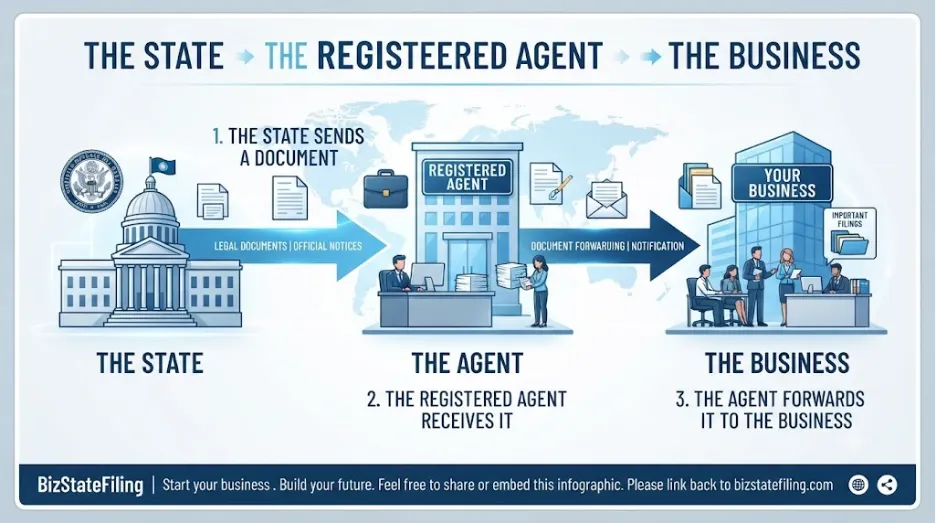
A Registered Agent (sometimes referred to as a resident agent or statutory agent) is an officially designated individual or business entity authorized to receive legal documents and government correspondence on behalf of a business enterprise (such as an LLC or Corporation).
A registered agent is an essential bridge between a business entity and the state government. In the United States, every business entity, whether it is an LLC, a corporation, or a partnership, is required by law tomaintaina registered agent. This individual or service provider acts as the official recipient for service of process, government correspondence, and other legal notifications. Understanding this role is fundamental for any entrepreneur looking to start a business ormaintainingan existing entity in good standing.
The primary function of a registered agent is to ensure that the state government and the legal system have a reliable method to communicate with your company. Without this official contact, a business could miss critical deadlines, tax notifications, or summons, which could lead to severe legal and financial consequences. The appointment of an agent is a non-negotiable step when you register a new business entity, and it serves as the foundation of administrative compliance.
The Legal Mandate for Registered Representation
The requirement for a registered agent is rooted in the principles of due process. Every state needs to guarantee that if legal action is brought against a company, that company receives notice ina timelyand official manner. This official notification process is known as the service ofthe process. A registered agent serves as the designated point of contact to ensure this process is respected.
Without a registered agent, the state has no assurance that a business is reachable. If a businessfails tomaintainan agent, they risk administrative dissolution. When a company is administratively dissolved, they lose their right to conduct business, lose the protection of the corporate veil, and may be forced to pay significant reinstatement fees. For those planning to buy a business , the presence of a properlymaintainedregistered agent is one of the first things that should be verified during the due diligence phase.
Core Responsibilities of the Agent
The responsibilities of a registered agent are specific and critical. They must be available during standard business hours at a physical address within the state of registration to accept hand-delivered legal documents. This includes:
-
Service of Process: Receiving lawsuits, summons, and subpoenas.
-
Official Government Correspondence: Receiving annual report reminders, tax notices, and franchise tax information.
-
Compliance Notifications: Receiving updatesregardingchanges in state statutes or reporting requirements.
The agent acts as the first line of defense for the company. They do notrepresentthe business in a legal sense, but they provide the essential service of ensuring the business is never caught off guard by legal filings.

Internal Registered Agent versus Professional Services
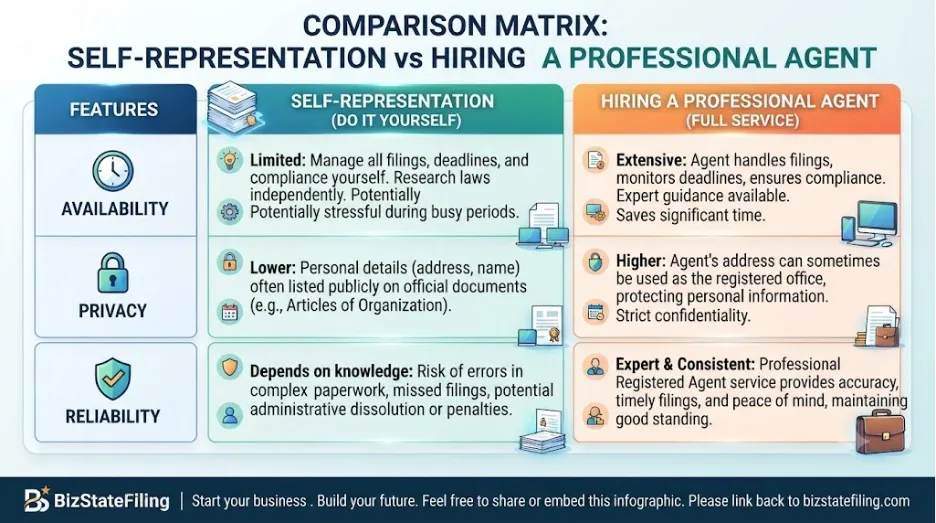
Deciding whether to serve as your own registered agent or hire a professional service is a strategic business decision. Small business owners often consider acting as their own agent to save on costs, whileestablishedcompaniesalmost exclusivelyprefer professional services for the sake of privacy and reliability.
|
Feature |
Internal Registered Agent |
Professional Service Provider |
|
Availability |
Limited by owner schedule |
Guaranteed business hours |
|
Address Privacy |
Personal address is public |
Uses agent business address |
|
Document Handling |
Manual scanning/filing |
Digital portal with history |
|
Scaling |
Difficult for multi-state |
Seamless across all states |
|
Reliability |
Dependent on human error |
Guaranteed service levels |
|
Audit Trail |
Manual tracking |
Secure digital audit trail |
|
Cost |
No upfront fee |
Small annual service fee |
The Impact of Address Privacy
One of the mostsignificant yetoften overlooked benefits of using a professional registered agent service is the protection of privacy. In many states, the registered agent address is a matter of public records. If you serve as your own agent, your home address or private office address becomes public information. This can lead to unwanted solicitations, privacy concerns, and security risks.
Professional agents provide their own office address to be listed on public filings. This creates a buffer between the public and your private place of business. For entrepreneurs whooperatefrom home, this is not just a luxury; it is a critical security measure. When you analyze your recurring costs, you should view the fee for a professional agent as an investment in security rather than a purely administrative expense. Using a subscription analyzer can help you track these costs as part of your overall budget management.
Integration with Operational Efficiency
Managing compliance should not be an overwhelming burden that distracts from core business activities. High-growth companies often struggle because they treat compliance as an afterthought. Integrating your compliance tasks into your daily workflow is essential.
Many executives use time blocker tools to dedicate specific hours to administrative reviews. By ensuring that your agent receives documentation, you must also have a process toforwardthose documents to the right person in your organization. If you are managing multiple entities, keeping track of different deadlines can become complex. Utilizing tools to track subscription costs can also help you manage your various service providers and ensure you are not overspending while ensuring your compliance stack is robust.
Scalability and Multi-StateExpansion
As your business grows and expands into new markets, your compliance requirements change. You cannot simplyoperateunder your home state rules in everyjurisdiction.You generally need to register as a foreign entity in every state where you do business.This foreign qualification process requires you to appoint a registered agent in each of those states.
Maintaining a registered agent in five, ten, or twenty states isvirtually impossiblefor a business owner to manage on their own. This is wherenationalprofessional service becomes invaluable. They canconsolidateyour compliance requirements into a single digital dashboard, ensuring you receive notices regardless of whichstatethey originate from. This level of organization is necessary when you aremonitoring business growth metrics and planning your next strategic move.
Data Security and Compliance
In the modern era,documentsreceived by a registered agent oftencontainsensitive information. Legal notices cancontainpersonal details, financial records, and confidential business secrets. Professional agents must adhere to strict data security standards. They should provide digital portals where you can securely access your documents, ensuring that they are not lost in the mail or handled by unauthorized parties.
If you are dealing with large volumes of data, it is important to ensure your internal processes are secure. Whether it is using a text redactor before documents leave your network or ensuring your internal records are properlymaintained, data integrity is acomponentof overall regulatory compliance. Protecting your digital footprint is just as important as protecting your physical legal status.
Financial Implications of Non-Compliance
The financial cost offailing to maintaina registered agent is often much higher than the annual cost of the service itself. A single default judgment against your company because you missed a lawsuit notification can cost your business more than the lifetime cost of professional agent services.
When you calculate business break-even point, you must include your compliance costs. If you are preparing to exit your business or bring in investors, your compliance record is a key part of your valuation. Investors want to see that you have handled your regulatory obligations with care. A messy, non-compliant history can kill a deal or significantly lower the valuation of your company.
Industry Specific Compliance
Different industries face different regulatory burdens. For instance, companies in the health and senior care sector are subject to intense scrutinyregardingpatient data and operational procedures. In these fields,failing to maintaincompliance can lead to the loss of licenses and severe government fines.
|
Industry |
Primary Compliance Concern |
Agent Role |
|
Healthcare |
Data protection and licensing |
Secure document delivery |
|
Manufacturing |
Environmental and safety |
Legal noticeforwarding |
|
Construction |
Licensing and permitting |
Official correspondence |
|
Retail |
Sales tax and permits |
State tax notifications |
|
Technology |
Data privacy and security |
Legal process reception |
|
Financial Services |
Audits and regulations |
Regulatory communication |
Strategic Planning for Regulatory Success
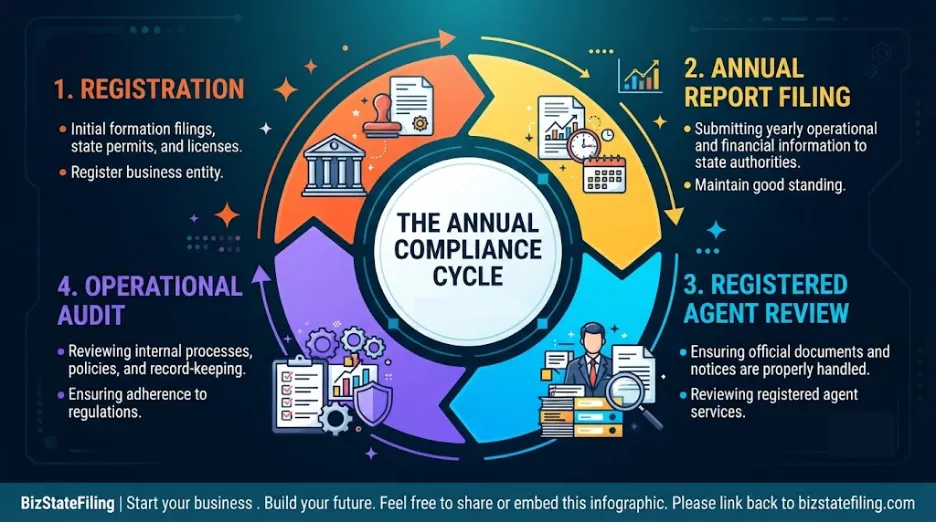
Success in business requires a proactive approach to allfacetsof operation, including compliance. Do not wait for a state notice to remind you that youragent'sinformation is outdated. Conduct a regular review of your entity status. Make it a habit to audit your business records annually.
If you are currently in a growth phase, use the time to ensure your infrastructure is sound. When you are looking to expand, assess the best cities for business before you register in a new jurisdiction. This helps you understand the local regulatory climate. Always ensure that your registered agent is ready to handle the increased load as you add more states to your portfolio.
The Role of Due Diligence
Before you decide to enter a new market, you must perform due diligence on the compliance requirements of that specific state. Using relocation intelligence can provide you with the data needed to make informed decisions about where to base your operations. Compliance is not just about filing forms; itisstrategic placement.
When you are ready to expand, ensure your documentation is clear. Whether you need to file an LLC, a corporation, or a partnership, your registered agent is the first link in your communication chain. If you are uncertain about the specific requirements, consulting with a franchise guide can also provide clarity if your business model involves licensing or franchising.
Managing Organizational Risks
The risk of non-compliance is never zero, but it can be minimized through rigorous process adherence. This involves creating a culture where compliance is integrated into the daily workflow rather than treated as an annual hurdle.
Staff training should be a corecomponentof your risk management. Employees who understand the reason behind your compliance processes are more likely to execute them correctly. This is true whether you are managing safety protocols on a shop floor or data handling procedures in an office environment. By investing in the human element of compliance, you create a more resilient organization that is better equipped to handle the complexities of the regulatory landscape.
Conclusion
A registered agent is far more than a name on a form. They are a critical partner in the long-term success and protection of your business. Whether you are just starting out or managing a multi-state enterprise, the reliability, privacy, and efficiency offered by a professional registered agent service are essential. Prioritize your compliance, protect your privacy, and ensure that youcan alwaysaddress legal and regulatory challenges as they arise.
Frequently Asked Questions
1.What is the primary purpose of a registered agent?
The primary purpose is to receive service of process and official state notices on behalf of a business to ensure that the business has a reliable way to receive legal information.
2.Can a business owner serve as their own registered agent?
Yes, in most states, a business owner can serve as their own agent, provided they have a physical address in the state and are available during normal business hours.
3.Why is a physical addressrequiredfor a registered agent?
The law requires a physical street address so that a process server can physically deliver legal documents, which cannot be done at a post office box.
4.What happens if I do not have a registered agent?
Your business may fall out of compliance, leading to administrative dissolution, loss of your corporate veil, and an inability to legally conduct business in the state.
5.How do I change my registered agent?
You can usually change your agent by filing a Change of Registered Agent form with the Secretary of State or by updating the information in your annual report.
6.Is a registered agent the same as a tax advisor?
No, a registered agent is not a tax advisor. They only handle legal notices and state correspondence, not your tax filings or strategic financial planning.
7.Does every staterequirea registered agent?
Yes, every state in the US requires business entities like LLCs and corporations tomaintaina registered agent in the state of formation and any state where they are qualified to do business.
8.Does using a registered agent service provide more privacy?
Yes, using a professional service allows you to use their address on public filings instead of your personal or home address.
9.How does a registered agentassistwith multi-state growth?
A professional agent with a national network can provide a single point of contact and a digital dashboard to manage compliance across multiplejurisdictions.
10.Are the fees for a registered agent tax deductible?
In most cases, the fee paid for a registered agent is considered a normal business expense and is tax deductible, but you should verify this with your accountant.
 Perplexity
 Claude
 Grok
Grok