





The regulatory landscape for businessesoperatingwithin the borders of Texas is distinctive and requiresa high levelof operational precision. Unlikejurisdictionsthatutilizea simple annual registration fee, Texasleveragesa comprehensivetaxbasedreporting system. For any founder planning to start a business in this state, understanding the intricacies of the franchise tax report is not just a suggestion but a critical requirement formaintaininggood standing. This guide serves as a deep dive into the filing obligations, statutory deadlines, and the broader financial disciplinerequiredto navigate the Texas regulatory environment effectively.
The Regulatory Framework of the Franchise Tax Report
In Texas, the terminology used for annual compliance often leads to confusion. While many refer to it as an annual report, the state formally requires the submission of a franchise tax report. This report is the primary vehicle through which the Texas Comptroller of Public Accounts assesses whether an entity is liable for state taxes. It is not merely a formality for updating officer information; it is a financial document that reflects your revenue, margins, and operational health.
When you manage your business in a significant economic hub like Dallas, you are subject to both state and local reporting standards. For deeper citylevel insights, visit Urblytica’s City Intelligence Dashboard . Every entity, whether it is an LLC, a corporation, or a partnership, must confirm its filing status annually. The state legislature adjusts revenue thresholdsfrequently, which means your obligations can shift from year to year. Proactive monitoring of these changes is essential to avoid the administrative pitfalls that often catch new entrepreneurs off guard.
Filing Mechanics and Deadlines
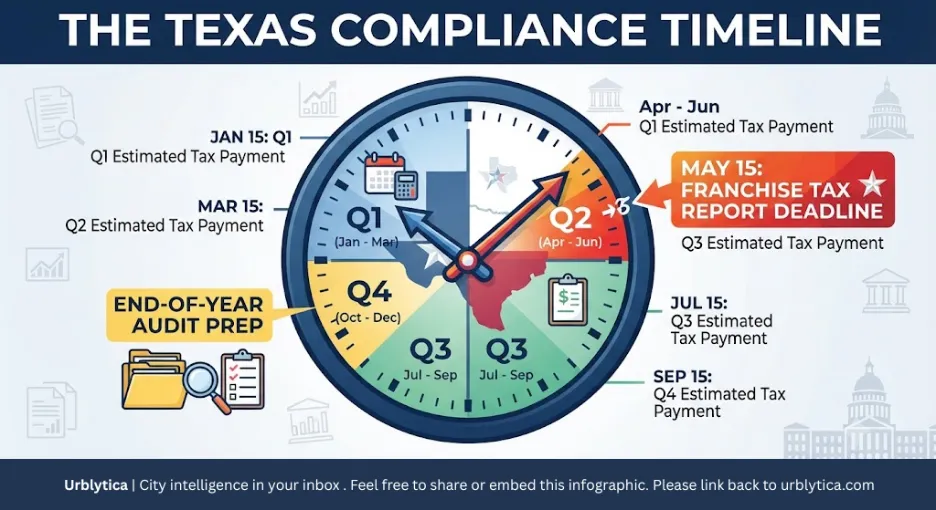
The absolute deadline for all franchise tax reports in Texas is May 15 of each year. If this date falls on a weekend or a legal holiday, the deadline is extended to the next business day. Being prepared for this date requires more than just meeting the cutoff; it requires an internal accounting cycle that concludes well before the spring.
If youoperateyour business out of a bustling metropolis like Houston, you need to manage your taxrelated workflows with high precision. For deeper citylevel insights, visit Urblytica’s City Intelligence Dashboard . Using professional tools to clean enterprise data ensures that your taxpayer ID and address information are verified, reducing the chance of manual errors. Most filings are processed through the official state portal, where having your entity registration details and financial statements ready is the standard for a frictionless experience.
Comparative Entity Obligations
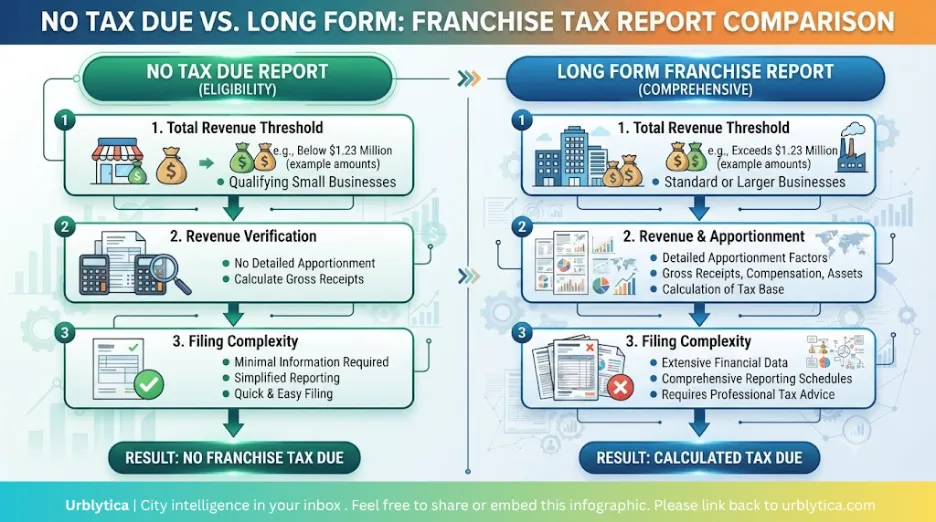
The requirements for your entity depend heavily on its structure. Understanding the nuance between a No Tax Due report and a Long Form report is essential. Below is an overview of how different business types in Texasgenerally interactwith the compliance framework.
|
Entity Type |
Reporting Frequency |
Primary Filing Document |
Tax Basis |
|
Limited Liability Company |
Annual |
Franchise Tax Report |
Revenue-based |
|
C-Corporation |
Annual |
Franchise Tax Report |
Revenue-based |
|
S-Corporation |
Annual |
Franchise Tax Report |
Revenue-based |
|
Professional Association |
Annual |
Franchise Tax Report |
Revenue-based |
|
General Partnership |
Annual |
Franchise Tax Report |
Revenue-based |
This tableprovidesahighlevelview, but it is important to remember that tax liability is often tied to total revenue. Founders who need to audit their operational expenses can use a subscription analyzer to ensure their cash flow predictions areaccurate, which in turn informs your financial planning for the upcoming tax season.
Financial Modeling for Compliance
Your ability to remain compliant rests on the accuracy of your financial modeling. You should view compliance costs as a fixed operational expense rather than an occasional burden. Whether you are scaling your operations in Austin or expanding your service territory, your financial health must be transparent. For deeper citylevel insights, visit Urblytica’s City Intelligence Dashboard .
When you are assessing your business performance, you should also calculate your Return on Investment (ROI) for any new equipment or marketing campaigns. The formula foryour ROI provides the metric needed to decide if your current path is sustainable. Bymaintaininga clean set of books, you transform the annual filing from a crisisto pointinto a routine administrative task. If you are struggling with accounting, consult accounting and finance professionals to bridge the gap.
Understanding the No Tax Due Report
Many small businesses fall under the statemandated revenue threshold. This does not mean you are exempt from filing. The No Tax Due report is a mandatory submission for entities that qualify. It serves as an official confirmation that your entity is active and that your revenue is below the taxable limit.
Failure to file this report is a common, and often expensive, mistake.Even if your tax liability is zero, the state will assess late fees for failing to file the documentation.If you are managing your operations in a city like San Antonio,maintainingthis compliance is anonnegotiablestep to protect your market position and your certificate of formation. For deeper citylevel insights, visit Urblytica’s City Intelligence Dashboard . When you are ready to expand or perhaps buy a business to grow your footprint, having a clean history of filed No Tax Due reports will be a primary item in your due diligence folder.
Penalties and Enforcement
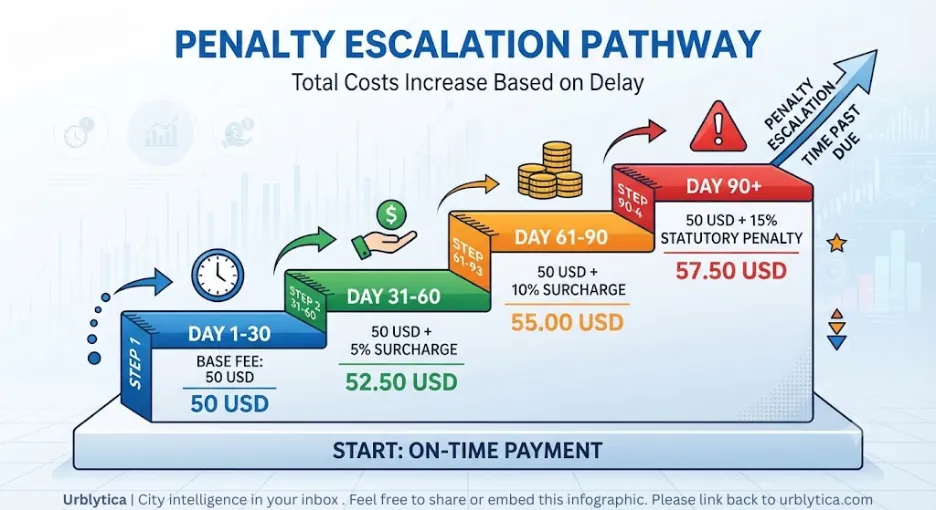
Texasutilizesa tiered penalty system to encouragetimelycompliance. These penalties are designed to scale with the length of the delinquency. If you do not meet your obligations by May 15, the following framework is typically applied:
|
Delay Period |
Penalty Type |
Financial Impact |
|
1 - 30 Days |
Late Filing Fee |
50 USD |
|
31 - 60 Days |
Additional Penalty |
50 USD + 5 percent of tax |
|
61 - 90 Days |
Compounded Penalty |
50 USD + 10 percent of tax |
|
90+ Days |
Statutory Penalty |
50 USD + 15 percent of tax |
This frameworkdemonstrateswhy procrastination is detrimental. As you look into business guides for managing these tasks, remember that these penalties are strictly enforced. Consistent recordkeeping using a time blocker can prevent these late filings. If you areoperatingin a competitive environment like Fort Worth, you cannot afford to have your right to transact business suspended for such easily avoidable reasons. For deeper citylevel insights, visit Urblytica’s City Intelligence Dashboard .
Strategic Operational Management
To avoid the penalties listed above, you should implement a recurring auditing schedule. Many business owners rely on a breakeven calculator tomonitortheir sustainability, but you should also track your regulatory filing schedule with the same level of discipline.Efficient operations require you to treat state compliance as a critical business KPI.
If you are involved in industries such as advertising and marketing , you must ensure that your professional certificationsremainvalid alongside your corporate standing. Professional services in cities like El Paso require this layered approach to compliance. For deeper citylevel insights, visit Urblytica’s City Intelligence Dashboard . Use the right tools tomaintainand manage your business lists, ensuring that the address you have on file with the state is alwaysaccurateand current.
Evaluating Business Growth in Texas
As your business grows, your filing obligations may change. If you have beenoperatingas a small startup and are now expanding your footprint, you might consider if your current entity structure is stilloptimal. Evaluating whether to buy a business ormergingwith another entity requires a full audit of the target company's franchise tax history.
Acquisitions often reveal hidden liabilities related to unpaid franchise taxes or missed reports. Always conduct due diligence beforefinalizingan acquisition. If you are in the planning stage of such a transition, ensure you have a clear strategy. For those looking for expansion opportunities, you can explore a franchise guide to understand how your entity structureimpactsyour eligibility for certain growth models. When evaluating your growth, check best cities for startups tooptimizeyour location strategy.

Leveraging Professional Resources
While many owners handle the franchise tax report independently, complex operations often require externalexpertise. Consulting with a tax professional who understands Texas statutes can help you navigate tax credits, deductions, and reporting requirements that you might otherwise overlook.
Staying informed about the latest legislative changes in Texas is essential for longterm viability. The state periodically updates its economicpolicies andbeing proactive rather than reactive is the key tomaintainingyour entity in good standing. Whether you are scaling your team or pivoting your business model, always align your operational choices with the regulatory requirements of the state. If yourequirefurther support, you can access information for the USA .
Data Management for Tax Accuracy
Accuracy in your filings requires clean and reliable data.If your business handles large volumes of client records or vendor information, ensure your datasets are sanitized to avoid errors in reporting.You can use tools to clean your enterprise lists, which prevents the frustration of incorrect filings due to outdated or duplicated information.Maintainingdata integrityiscritical for tax reporting as it is for marketing or operational efficiency. Your data hygiene dictates your ability to pass audits andmaintainconsistent reporting.
Frequently Asked Questions
1.Is the Texas franchise tax report the same as an annual report?
Yes, in Texas, the franchise tax report serves the purpose of an annual filing for most taxable entities tomaintaingood standing with the state.
2.When is the franchise tax report due in Texas?
The filing deadline is May 15 of each year.
3.Do I have to file if my business has zero revenue?
Yes, even if your business has zero revenue or falls below the tax threshold, you must file a No Tax Due report to remain compliant.
4.What is the penalty for filing my franchise tax report late?
The state imposes a minimum late filing fee of 50 USD, which can increase significantly withadditionalpenalties based on the amount of tax owed as time progresses.
5.How do I file the Texas franchise tax report?
The report is typically filed electronically through the Texas Comptroller of Public Accounts online portal.
6.What happens if Ifail tofile my franchise tax report?
Failure to file can lead to the forfeiture of your right to transact business in Texas, including the loss of your certificate of formation.
7.Which entities are subject to the Texas franchise tax?
Most entities, including LLCs, corporations, and partnerships that conduct business in Texas, are subject to the franchise tax.
8.Is there an extension available for the franchise tax filing?
Taxpayers canapplyan extension to file if they meet specific criteria, but they must do so before the original deadline.
9.Does my entity structure affect my tax reporting?
Yes, the type of entity you have maydeterminewhich specific forms you must file and how your tax liability is calculated.
10.Where can I find help with my Texas business compliance?
You can consult official state resources through the Comptroller or use professional business filing services like BizStateFiling to manage your regulatory requirements.
 Perplexity
 Claude
 Grok
Grok
